Heat- and stress-sensitive devices, such as silicon photomultipliers and piezoelectrics with a low Curie temperature, have to be soldered as cold as possible. Gallium-copper alloy pastes make that possible: they join copper below 120 °C, without flux or lead, and the joint can then be used at much higher temperatures.
I. Introduction
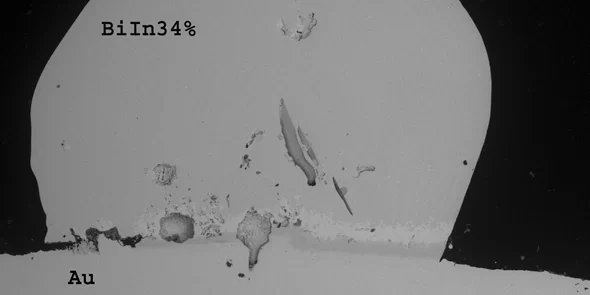
The stresses that build up as a joint cools after soldering can affect how an electronic assembly performs. The lower the soldering temperature, the smaller those stresses. In earlier SMTA papers we used Bismuth-Indium alloys with 34 wt.% Indium, but their low melting point also limits the operating temperature of the joint.
Gallium melts at 29.8 °C and wets most metal surfaces used in electronics. Mixed with a copper powder it forms a paste. At the bonding temperature the liquid Gallium reacts with the powder and with the parts being joined, until no liquid is left. This is Transient Liquid Phase (TLP) bonding: the joint is made at 120 °C, and the solidified product can serve up to about 200 °C.
Earlier work with dendritic copper powder gave mixed and poorly reproducible results. This study set out to:
develop a way to make Gallium powder, which is not commercially available;
formulate pastes from spherical copper powder and Gallium in a Ga to Cu ratio of 1:2 (66 wt.% Cu);
explain the reactions during curing on copper and silver with phase diagrams and diffusion kinetics;
assess whether these pastes are suitable for low-temperature solder joints.
II. Experimental
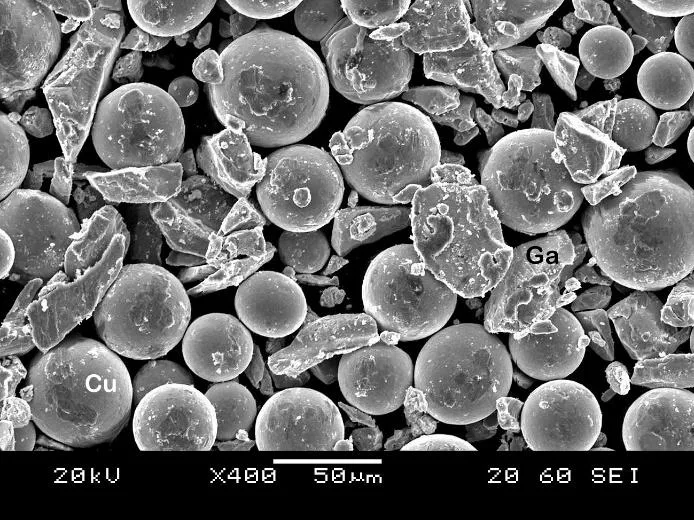
Gallium was pulverised under liquid Nitrogen and sieved to a fraction below 32 µm, giving a flowable powder of sharp, acicular particles. Two kinds of GaCu66 paste were made with spherical copper powder (20 to 70 µm):
powder-powder: Gallium powder and copper powder mixed at room temperature;
powder-liquid: copper powder blended into liquid Gallium at about 70 °C.
Spherical copper powder mixed with the sharp-edged, cryo-pulverised Gallium powder (SEM, 400×).
The pastes were applied to copper and silver substrates, with a copper wire embedded to mimic an interconnect, and cured at 120 °C for 4 to 16 hours. Cross-sections were examined by optical microscopy, scanning electron microscopy and electron-probe microanalysis (EPMA/EDS).
III. Results
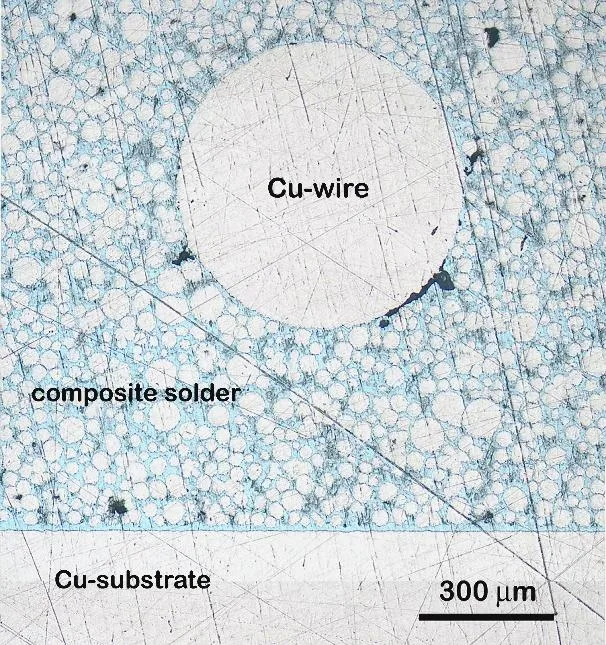
On copper. With both pastes, all of the Gallium was converted into the CuGa2 intermetallic, and the paste bonded well to the substrate and to the wire. The powder-powder paste left many voids. The powder-liquid paste showed hardly any. Its Kirkendall plane, a weak spot in any joint, lies inside the CuGa2 layer rather than at the interface with the substrate.
Copper wire joined to a copper substrate with the powder-liquid paste (120 °C, 16 hours). The light blue phase is CuGa₂.
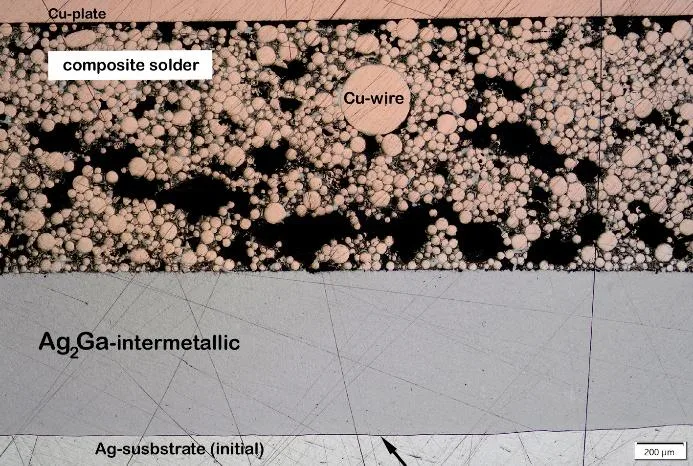
On silver. Gallium reacts with silver much faster than with copper. The substrate draws the liquid out of the paste, which leaves large voids, while a thick layer of Ag2Ga grows. A silver-to-silver joint made with a plain Gallium interlayer (120 °C, 16 hours) did bond well. Its two Kirkendall planes remain separate instead of merging.
The same paste cured on silver. A thick Ag₂Ga layer has grown, and the paste above it is full of voids.
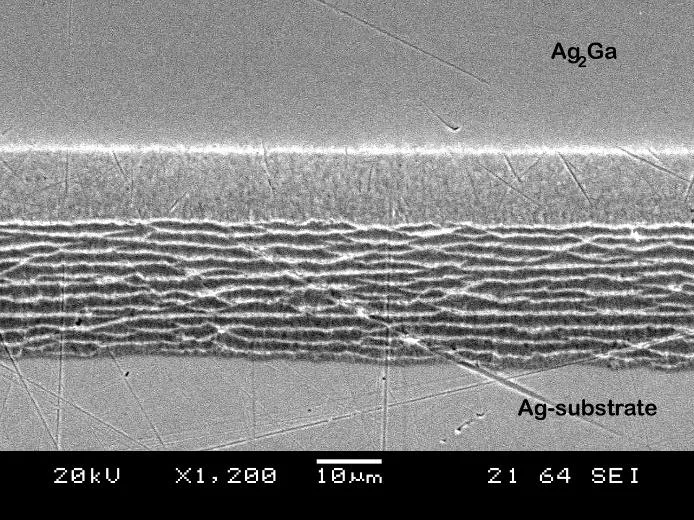
At the silver interface a periodic, banded structure forms, with layers of oxygen-containing particles in the Ag2Ga. The likely cause is the very stable Ga2O3 surface oxide on Gallium. Fragments of it act as markers of where the liquid surface was each time it broke up and re-formed.
Periodic bands in the Ag₂Ga layer next to the silver substrate (SEM, 1,200×).
IV. Conclusions
A flowable Gallium powder can be made by cryo-pulverisation under liquid Nitrogen.
GaCu66 pastes can be made from powders at room temperature, or by blending copper powder into liquid Gallium at 70 °C.
Both join copper to copper below 120 °C, and the joints are expected to work at higher temperatures. The powder-liquid paste currently gives the better joints.
TLP bonding with a Gallium interlayer joins silver at 120 °C. With GaCu pastes on silver, a reaction barrier is needed.
V. Future work
Compact the powder mixture before use, to reduce the effect of the Gallium oxide and the voiding.
Add a reaction barrier (Nickel or Ni(P)) on silver, or a thin silver layer on copper to improve adhesion.
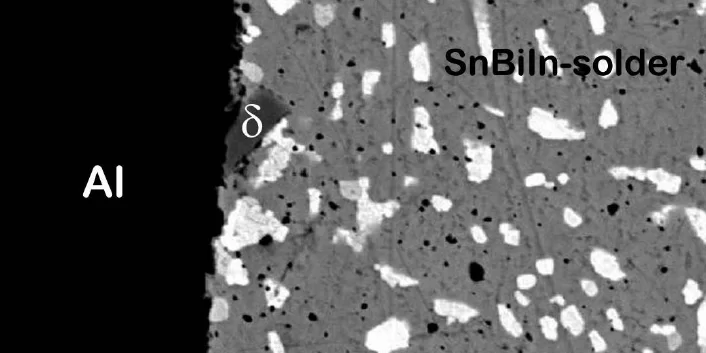
Look at a Sn-In-Bi eutectic (melting point about 58 °C) as a constituent that is easier to store than Gallium.
Combine with vapour-phase soldering for close control of the process temperature.
VI. Authors
M. Mulder, A. Miles, M. Biglari and A. Kodentsov, Mat-Tech BV. Presented at SMTA International, 25 to 29 October 2026, Rosemont, IL, USA, and published in its proceedings (pp. 241-249).
We would like to use cookies to see how the website is used (statistics) and to measure our advertising (marketing). What the website needs to work is always on. You can change your choice at any time under “Cookie settings” at the bottom of every page. Cookie policy